
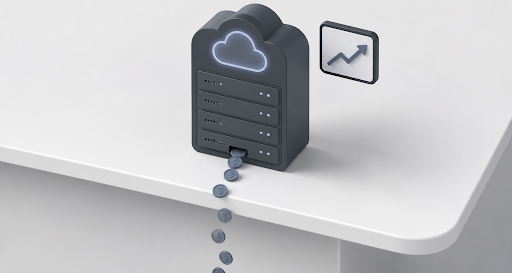
That quiet creep is exactly why Flexera’s 2026 State of the Cloud Report found that wasted cloud spend climbed back up to 29 percent this year, reversing five straight years of improvement, driven largely by AI workloads and new service pricing models that make costs harder to predict than ever. The full findings are available here: Flexera 2026 State of the Cloud Report. For a Charlotte business without dedicated oversight, that waste does not announce itself. It just quietly compounds.
Where the money actually leaks: idle and forgotten resources
The single most common source of cloud waste is also the most boring. Virtual machines spun up for a project that ended months ago. Storage volumes left behind after a server migration. Test environments that were meant to be temporary and simply never got shut down. None of this shows up as a dramatic line item. It shows up as a slow, steady increase that nobody traces back to its source because nobody is specifically looking.
Where the money actually leaks: paying for capacity nobody uses
The second major leak comes from resources sized for a worst case scenario that never happens. Businesses often provision cloud capacity based on their busiest possible day and then pay for that same capacity every single day of the year, whether it is needed or not. Right sizing this properly, matching capacity to actual usage patterns rather than worst case guesses, is one of the fastest ways to recover meaningful savings without touching performance at all.
Where the money actually leaks: subscription sprawl nobody owns
As businesses adopt more cloud based software, it becomes remarkably easy for multiple departments to independently purchase overlapping tools without anyone noticing the duplication. A proper Cloud Services partnership brings visibility to this exact problem, auditing what is actually being paid for against what is actually being used, and eliminating the overlap that accumulates when nobody owns the full picture.
This is a particularly common blind spot for architecture firms and design focused businesses juggling multiple specialized software platforms, where licensing costs can quietly stack up across teams using slightly different tools for overlapping purposes.
Where the money actually leaks: growth nobody planned the infrastructure around
Businesses that scale quickly, particularly those adopting connected devices and automation, often add cloud dependent systems faster than anyone is tracking their cumulative cost. Building automation systems increasingly rely on cloud connectivity for monitoring and control, and each new connected system adds its own small, easy to overlook cost that rarely gets evaluated against the value it delivers.
Why this connects to a bigger planning problem
Cloud waste rarely exists on its own. It is usually a symptom of the exact issue covered in what a Charlotte business actually needs from its IT setup in 2026, where strategy and oversight get skipped in favor of reacting to whatever feels urgent. A business running on managed IT services with proper oversight rarely experiences this kind of quiet cost creep, simply because someone is actually watching the full picture on an ongoing basis rather than only reacting when the bill becomes impossible to ignore.
The fix is a lot less painful than most owners assume
Recovering this waste does not require a disruptive overhaul or ripping out working systems. It requires a proper audit of what is actually running, what it actually costs, and what it is actually worth, followed by a plan to right size, consolidate, and retire what no longer earns its place. Most businesses are surprised by how much can be recovered without touching a single thing employees actually interact with day to day.
A cloud bill that quietly climbs every year is not a fixed cost of doing business, it is a solvable problem that just needs someone actually looking at it. gTECHserv audits, right sizes, and manages cloud environments for Charlotte businesses so growth does not come with a hidden tax attached. Reach out and find out what your cloud setup is actually costing you.
Frequently asked questions
How do I know if my business is overpaying for cloud services?
A clear sign is a monthly cloud bill that has grown steadily over the past year without a corresponding increase in usage or business activity. A proper cloud audit compares what you are paying for against what is actually being used to identify the gap.
Is switching to a cheaper cloud provider the best way to cut costs?
Not usually. Most savings come from right sizing and eliminating waste within your current setup rather than switching providers entirely, which often introduces migration costs that outweigh any short term savings.
Does moving to the cloud always save money compared to on premise servers?
Not automatically. Cloud services offer real advantages in scalability and reliability, but without ongoing oversight, costs can grow just as unpredictably as any other unmanaged expense.
Do businesses in Gastonia or Matthews face the same cloud cost challenges as those in Charlotte?
Yes, cloud cost waste is not tied to any particular city, since it stems from how resources are provisioned and managed rather than location. Businesses throughout the greater Charlotte region face the same underlying risk without proper oversight.