
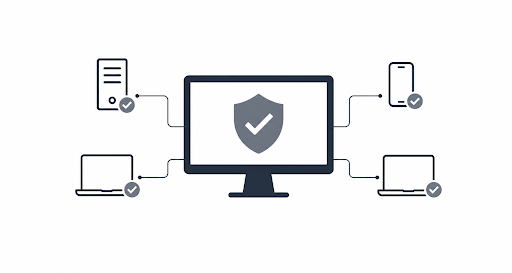
Peace of mind is not a marketing phrase. It is a measurable outcome, and business owners who have actually experienced it can usually point to the exact week it started. For most, that week lines up precisely with the switch to managed IT services. Not because a single problem got fixed, but because an entire category of background anxiety quietly disappeared.
What changes is not just the technology. It is what the business owner stops having to think about at eleven at night. Here is what these owners actually figured out, and why it made such a measurable difference.
They stopped carrying every technology decision alone
Before switching, many business owners in Charlotte were the default decision maker for every technology problem, whether or not they understood the problem at all. A slow computer, a suspicious email, a software renewal notice, all of it eventually landed on their desk because there was nobody else positioned to make the call. This is an exhausting way to run a business, and it is a major undercurrent in why U.S. Bank’s most recent Small Business Perspective survey found that 63 percent of small business owners feel overwhelmed by the sheer number of tools and technology decisions they are expected to manage, with 82 percent saying consolidating that burden is now a genuine priority. You can review the full findings here: U.S. Bank Small Business Perspective Survey. A proper managed IT services partnership absorbs that decision making load entirely, giving owners a single team to lean on instead of a stack of half understood tools.
They know exactly what downtime actually costs them
Owners who have not made the switch tend to think of an outage as an annoyance. Owners who have made the switch think of it in very specific terms, because at some point their provider walked them through the real number, factoring in lost billable hours, missed client deadlines, and the staff time spent simply waiting around. Once that number is attached to a real dollar figure, protecting against it stops feeling optional.
They know cybersecurity is not a task, it is a posture
Before switching, security often meant installing antivirus once and hoping for the best. After switching, business owners describe a completely different relationship with the topic. It becomes an ongoing posture rather than a box that got checked years ago. A proper Cybersecurity Protection Services setup means threats are being watched for continuously, not discovered after the damage is done, and that shift alone removes an enormous amount of quiet, background dread that many owners did not even realize they were carrying until it was gone.
This matters even more for businesses handling sensitive data day to day. A healthcare practice managing patient records under strict compliance requirements has a very different risk profile than a retail storefront, and owners in these fields describe the switch to managed cybersecurity as less of an upgrade and more of a genuine relief.
They know their infrastructure can actually keep up with them
Owners who scaled their business without ever revisiting their technology setup often discover, usually the hard way, that their systems have quietly become the bottleneck. Business owners who made the switch typically went through a proper cloud services and migration process at some point, moving away from aging on premise systems toward infrastructure that scales with the business rather than holding it back. This is closely tied to getting the fundamentals right in the first place, the same foundational thinking covered in what a business actually needs from its IT setup in 2026, where reliability has to come before anything more advanced can be trusted.
They know who to call, and that alone changes everything
Perhaps the simplest realization, and the one owners mention most often, is knowing exactly who to call when something goes wrong, and trusting that the call will actually get answered. Before the switch, this was rarely true. A random freelancer, a nephew who was good with computers, or a rotating cast of vendors left owners without a consistent point of contact. After the switch, there is one number, one team, and one relationship built on actually knowing the business.
What this adds up to
None of these realizations are dramatic on their own. Together, they remove an entire layer of low grade stress that most business owners had simply learned to live with, mistaking it for a normal part of running a company. It is not normal, and the owners who made the switch are the ones who found that out first.
There is a specific, identifiable reason business owners who made this switch stopped losing sleep over their technology. It was not luck, and it was not a bigger budget. It was simply having the right team in place. gTECHserv would like to be that team for your business. Reach out today and find out what changes once someone else is finally watching your systems around the clock.
Frequently asked questions
How quickly do business owners typically notice a difference after switching to managed IT services?
Most owners report a noticeable shift within the first month, largely because monitoring and support structure are put in place quickly. The deeper sense of peace of mind tends to build over the following few months as ongoing issues stop recurring.
Is managed IT services only worth it for larger companies?
No, small businesses often benefit the most, since they typically lack the internal resources to handle monitoring, security, and support on their own. The relief owners describe tends to be most pronounced in smaller, leaner organizations.
What is the biggest mental shift business owners describe after switching?
Most describe a shift from reactive worry to quiet confidence, no longer bracing for the next technology surprise because problems are being caught and handled before they become a crisis.
Does gTECHserv support businesses in Huntersville or Rock Hill in addition to Charlotte?
Yes, gTECHserv supports businesses throughout the greater Charlotte region, including Huntersville, Rock Hill, and surrounding communities, with the same proactive approach to IT support.