
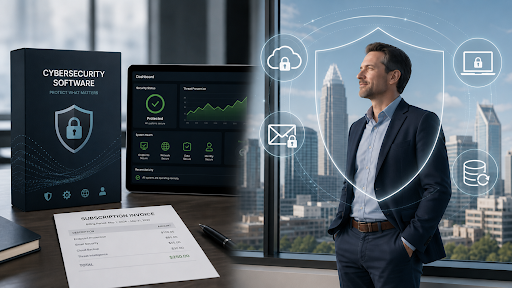
A software subscription can make a business feel protected long before it actually is. The dashboard looks clean, the product name sounds impressive, and the monthly invoice creates the sense that cybersecurity has been handled. But for Charlotte companies, cybersecurity services Charlotte, NC businesses rely on should deliver more than installed tools. They should deliver confidence that threats are being monitored, alerts are being reviewed, employees are supported, backups are tested, and someone knows what to do when something goes wrong.
That is the difference between buying cybersecurity software and buying cybersecurity peace of mind. One gives you a tool. The other gives you a working security system around the tool.
Cybersecurity Software Is Not the Same as Cybersecurity
Many businesses treat cybersecurity like a shopping list. Antivirus. Firewall. Email filter. Password manager. Backup tool. Endpoint protection. Maybe a monitoring platform. Each product may be useful, but buying tools does not automatically create protection.
A tool needs to be configured correctly. It needs to be monitored. Alerts need to be reviewed. Updates need to be applied. Exceptions need to be questioned. Employees need to know what to do. Backups need to be tested. Access needs to be managed. Leadership needs to understand the risks that still remain. Without that structure, cybersecurity software can create false confidence. The business believes it is protected because products exist, but nobody is actively connecting those products into a real defense strategy.
The False Comfort of a Green Dashboard
One of the most dangerous things in cybersecurity is a dashboard that looks calm while risk is building underneath. A system may show that devices are protected, but that does not mean every device is patched. An email security tool may block obvious threats, but that does not mean employees are safe from business email compromise. A backup platform may show completed jobs, but that does not prove the business can recover quickly.
Green checkmarks are useful only when someone understands what they do and do not mean.
This is where managed cybersecurity becomes different from basic software ownership. A provider should be reviewing the environment, asking better questions, and helping the business understand where protection is strong and where it is still thin.
Peace of Mind Comes From Process
Real cybersecurity peace of mind comes from repeatable process. That means your business has clear controls, clear responsibilities, and clear response steps. It means security is not dependent on one person remembering to check something when they have time.
For a Charlotte business, this process may include regular security reviews, endpoint monitoring, email protection, Microsoft 365 security checks, multi-factor authentication, access reviews, employee training, vulnerability scanning, backup testing, and incident response planning. These pieces work together. If one control fails, another should reduce the damage. If an employee clicks a bad link, email protection, MFA, endpoint monitoring, and quick reporting should all help limit the risk. Cybersecurity peace of mind is not built from one perfect product. It is built from layers that support each other.
Your Employees Need Support, Not Just Rules
Many companies buy cybersecurity software and then expect employees to magically behave securely. That is not realistic. Employees are busy, and attackers know how to create urgency, confusion, and trust. A finance employee may receive a fake vendor payment request. A manager may get a convincing Microsoft 365 login prompt. A sales employee may open a file that appears to come from a prospect. An executive may receive a text pretending to be from another leader.
Strong IT support Charlotte, NC companies depend on should help employees respond safely in these moments. They need a clear way to report suspicious emails, verify unusual requests, and get help without feeling blamed. Security tools matter, but employee behavior improves when the process is simple and the support is immediate.
Email Security Is a Business Control
Email is one of the most important business systems your company has. It carries contracts, invoices, approvals, client communication, internal decisions, and file-sharing links. That makes email security a business control, not just an IT setting.
Cybersecurity software can filter messages, block known threats, and flag suspicious activity. But peace of mind requires more. It requires multi-factor authentication, monitoring for unusual logins, employee awareness, payment verification habits, mailbox permission reviews, and clear escalation when something feels wrong.
The Cybersecurity and Infrastructure Security Agency provides practical guidance on phishing-resistant multifactor authentication, which is important because password-only protection is no longer enough for businesses that depend on cloud accounts and email systems. For Charlotte businesses, stronger email security can prevent one compromised inbox from becoming a financial, operational, or reputational problem.
Endpoint Protection Needs Human Oversight
Endpoint protection is another area where businesses often confuse product ownership with protection. Laptops, desktops, and mobile devices are now entry points into the company. A security product may detect suspicious behavior, but someone still needs to review alerts, investigate patterns, isolate risky devices, and confirm whether the threat is real.
That is why endpoint protection should be part of managed cybersecurity, not a set-it-and-forget-it tool. If alerts are ignored, misconfigured, or buried in noise, the software cannot provide peace of mind. A strong cybersecurity partner helps turn endpoint data into action. They look for repeated issues, outdated systems, unusual activity, missing patches, and devices that may not be following policy. The value comes from what happens after the tool raises its hand.
Backup and Recovery Are Part of Security
Some businesses think of backup as separate from cybersecurity. That is a mistake. If ransomware, accidental deletion, system failure, or account compromise affects your data, your backup and recovery plan becomes the difference between disruption and survival. A backup product alone is not enough. Peace of mind comes from knowing backups are monitored, protected, tested, and documented. The business should know which systems are critical, how quickly they can be restored, who is responsible for recovery, and what happens if the primary environment is unavailable.
This is why backup and disaster recovery should be included in the cybersecurity conversation. A secure business is not only harder to attack. It is also better prepared to recover.
Software Cannot Replace Strategy
Cybersecurity products are important, but they cannot replace strategy. They cannot decide which risks matter most to your business. They cannot explain whether your access controls match your operations. They cannot train employees in the exact scenarios they face. They cannot reassure customers after an incident. They cannot lead your recovery plan.
Strategy connects tools to business reality.
For example, a healthcare-related business may need stronger controls around sensitive records. A financial services firm may need tighter email and payment verification processes. A construction company may need protection around vendor communication and project files. A professional services firm may need secure cloud access and stronger client data controls.
The right managed IT services Charlotte, NC businesses use should help align cybersecurity with how the company actually operates.
The Questions That Reveal the Difference
Ask your current provider what happens when an alert is triggered after hours. Ask whether backups are tested or simply assumed to work. Ask who reviews cloud permissions. Ask how often employee access is audited. Ask what happens if a laptop is lost. Ask whether phishing reports are tracked. Ask what your top three security risks are right now.
If the answers are vague, you may own cybersecurity software without having cybersecurity peace of mind.
A serious provider should be able to explain the tools, the process, the people, and the response plan. They should not hide behind product names. They should help leadership understand what is protected, what still needs work, and what decisions need to be made next.
Buy Outcomes, Not Just Tools
Cybersecurity software can be valuable, but only when it is part of a managed, monitored, and tested security program. The real purchase is not antivirus, email filtering, endpoint protection, or backup software. The real purchase is fewer surprises, faster response, stronger recovery, safer employees, and better confidence in the systems your business depends on.
gTECHserv helps Charlotte businesses move beyond tool-based security with cybersecurity services, managed IT services, IT support, email security, endpoint protection, and backup and disaster recovery built around practical business protection. If your company is paying for security tools but still unsure who is watching, testing, responding, and improving the environment, then you have not bought peace of mind yet. You have only bought software.
FAQs
What is the difference between cybersecurity software and cybersecurity services?
Cybersecurity software is a tool, while cybersecurity services include the setup, monitoring, management, response, training, and strategy needed to turn tools into real protection for Charlotte businesses.
Do Charlotte businesses still need cybersecurity software?
Yes. Cybersecurity software is important, but it should be part of a larger security program that includes monitoring, access control, employee training, backup testing, incident response planning, and ongoing review.
Why is managed cybersecurity better than only buying security tools?
Managed cybersecurity is stronger because someone is actively reviewing alerts, improving settings, checking risks, supporting employees, testing recovery, and helping leadership understand what needs attention.
What should cybersecurity peace of mind include?
Cybersecurity peace of mind should include email security, endpoint protection, MFA, patching, access reviews, backup testing, employee awareness, threat monitoring, and a clear incident response plan.